

What to Consider When Choosing a Band Saw? A Comprehensive Buying Guide for Professionals.
Choosing a band saw machine is an important investment decision that is not limited to merely comparing technical specifications. Many criteria such as the purpose of use, the type of material to be cut, engine power, cutting capacity, saw blade quality, safety systems, ease of maintenance and energy efficiency should be evaluated together. Band saw […]
Choosing a band saw machine is an important investment decision that is not limited to merely comparing technical specifications. Many criteria such as the purpose of use, the type of material to be cut, engine power, cutting capacity, saw blade quality, safety systems, ease of maintenance and energy efficiency should be evaluated together.
Band saw machines are among the professional equipment that enables precise, safe, and efficient cutting of wood, metal, plastic, and many other materials. These machines, which have a wide range of uses from furniture production facilities to carpenters’ workshops, from steel construction enterprises to industrial production lines, significantly reduce operating costs while improving production quality when selected correctly.
There are numerous band saw models on the market, each with different capacities, motor powers, and intended uses. Therefore, instead of making a choice solely based on price, it will be much more advantageous in the long run to analyze production needs accurately and select the appropriate machine accordingly.
In this guide, we cover in detail the technical criteria, usage areas and professional selection tips that should be considered when purchasing a band saw machine.
What is a Band Saw Machine?
A band saw machine is a professional machine that cuts using a thin, long saw blade that rotates continuously between two pulleys. Unlike circular saws, thanks to the saw band operating in an uninterrupted cycle, more precise, controlled cutting can be achieved with reduced material loss.
Band saws achieve high success not only in straight cuts but also in curved cuts. It offers significant advantages, especially in the production of parts with complex geometries.
In advanced models, thanks to the cutting speed, table slope, automatic feeding systems and digital control features, it can be easily adapted to different production needs.
Determine Your Purpose of Use Accurately
The first step in machine selection is to determine what materials you will be processing. There are significant technical differences between a band saw used in the woodworking industry and models developed for metal cutting.
While woodworking businesses require higher cutting speeds, metal cutting demands lower speeds and a more robust structure.
Before purchasing, it would be helpful to answer the following questions:
- What material will be cut?
- What is the daily production capacity?
- Will mass production be carried out?
- Is precision cutting or rough cutting more important?
- What will be the maximum cutting height and width?
- Proper needs analysis prevents the purchase of machines that are either larger than necessary or of insufficient capacity.
Motor Power Directly Affects Performance
In band saw machines, motor power is one of the most important technical specifications. Powerful motors operate more stably during intensive production processes and do not experience performance loss with thick and hard materials.
Insufficient motor power causes:
- Decreased cutting speed,
- Straining of the band saw,
- Overheating of the motor.
- It may lead to increased energy consumption,
- and reduce production efficiency.
- When selecting a motor, not only horsepower should be considered, but also continuous operating performance and energy efficiency.
Cutting Capacity Must Match Business Needs
Not every band saw machine has the same cutting capacity. The maximum height and width that the machine can cut must be suitable for the dimensions of the parts to be produced.
While compact models may be sufficient for small workshops, businesses engaged in industrial production should opt for machines with a larger working area.
Purchasing a machine with excessive capacity beyond your needs creates unnecessary costs, while insufficient capacity can limit production processes.
The Quality of the Band Saw Blade is at Least as Important as the Machine Itself
Many users may overlook the importance of the saw blade used while focusing on the machine. However, one of the key factors determining cutting quality is the correct saw blade.
A quality band saw selected appropriately for the material;
- Provides a cleaner cut.
- Creates fewer burrs.
- Remains sharp for longer.
- It increases cutting accuracy.
- It contributes to more efficient operation of the machine.
- The strip width, tooth structure, tooth pitch, and steel grade must be determined based on the material to be used.
Body Structure and Chassis Durability
The machine’s body directly affects the vibration level. Machines with heavy and robust bodies produce less vibration during operation and enable more precise cuts.
Machines with poor-quality body structures may experience adjustment malfunctions over time. This condition may adversely affect cutting accuracy and increase maintenance costs.
Models with cast iron bodies or high-strength steel construction offer reliable performance for many years.
Cutting Speed Should Be Adjustable
Different materials require different cutting speeds. While high speeds provide an advantage in woodworking, lower speeds are preferred in metal cutting.
Machines with variable speed control offer significant advantages to the user.
Thanks to adjustable speed;
- The team life is extended.
- Cutting quality improves.
- Material burns are prevented.
- More precise production can be achieved.
- The same machine can be used for different materials.
- This feature is an especially significant advantage for businesses engaged in versatile production.
Table Design and Ergonomics
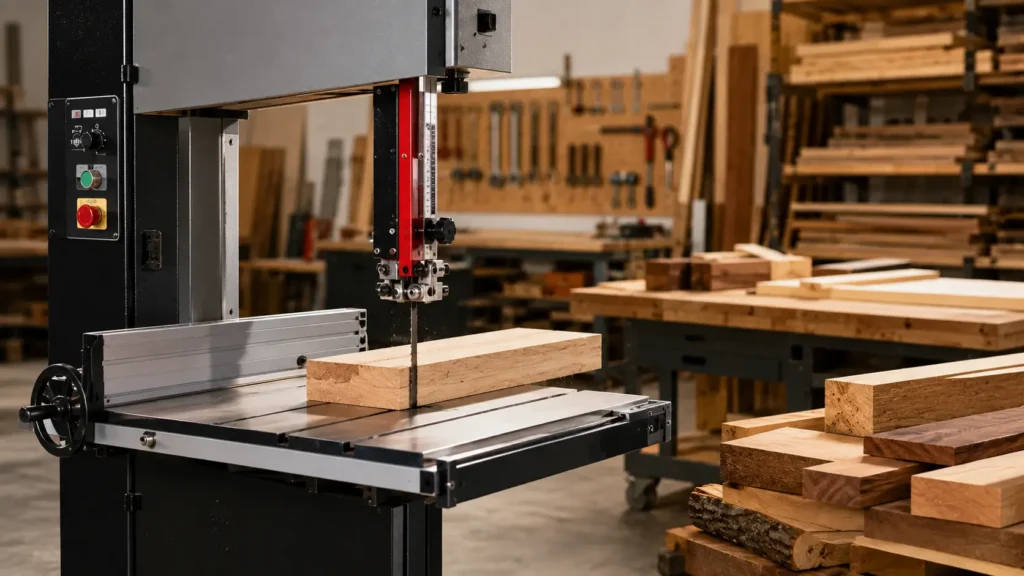
The worktable is an important component that affects both operator comfort and cutting precision.
A quality table;
- should offer a large working area.
- should be easily adjustable.
- It must be made of durable material.
- It must allow the material to move freely.
- Precise angle adjustment must be possible.
- In some professional models, angled cuts can be easily performed thanks to the tilting table system.
Safety Equipment Should Not Be Neglected
Since band saw machines are high-speed cutting equipment, safety features are of great importance.
Safety systems found in modern machines include:
- Emergency stop button
- Track protection cover
- Motor overload protection
- Safety switch systems
- Lane departure sensors
- Automatic braking mechanisms are included.
These systems not only enhance operator safety, but also prevent damage to the machine.
Dust Extraction System and Clean Working Environment
Especially in the woodworking industry, a large amount of sawdust and fine dust is generated during cutting. This condition can negatively affect both occupational safety and cutting precision.
Machines equipped with dust extraction connections;
- Creates a cleaner working environment.
- Extends the machine’s lifespan.
- Protects operator health.
- It provides a clearer view of the cutting line.
- In professional manufacturing facilities, machines operating with central dust collection systems are preferred.
Ease of Maintenance and Spare Parts Support
When purchasing a machine, attention should be paid not only to technical specifications but also to after-sales services.
Machines that are easy to maintain support production continuity.
Additionally, the following criteria are also important:
- Spare parts availability
- Technical service network
- Warranty period
- User manual support
- Periodic maintenance services
- For an investment that will be used for many years, strong service support provides a major advantage.
Energy Efficiency Reduces Operating Costs
Energy consumption is a significant cost factor, especially in continuously operating production facilities. New generation motor technologies can deliver high performance while consuming less energy.
Energy-efficient machines;
- Reduces electricity expenses.
- Operates more quietly.
- Produces less heat.
- Contributes to environmentally friendly production.
- Machines that provide long-term energy savings can recoup their investment cost in a short time.
A properly selected band saw machine ensures more precise cuts, lower waste rates, longer equipment life, and more efficient production processes. For furniture manufacturers, carpenters’ workshops, metal processing plants and industrial production enterprises, the choice of machines suitable for the needs is an important factor that directly affects both quality and business profitability.
When creating a professional investment plan, taking into account not only today’s needs, but also future production capacity will provide an important advantage in choosing the right machine.